Survey on Design Practitioners Perception on AI Transformation in Design Industry

1 Overview
- This project was conducted to collect foundational data for building a platform that integrates AI and big data into the design process, as part of preparing the design industry for AI-driven transformation. The goal was to deepen contextual understanding by surveying how generative AI and big data are actually being used within real design workflows in the domestic design industry, and what expectations and concerns practitioners hold.
- Over approximately three months, the survey targeted design practitioners and stakeholders across the domestic design industry, collecting a total of 538 valid responses. Based on these responses, the research systematically examined the current state of data utilization, expectations and concerns around generative AI, bottlenecks in the design process, and the competencies designers will need going forward.
- Role: Survey instrument design, distribution strategy and execution, response collection, quantitative statistical analysis, qualitative thematic analysis, structural equation modeling.
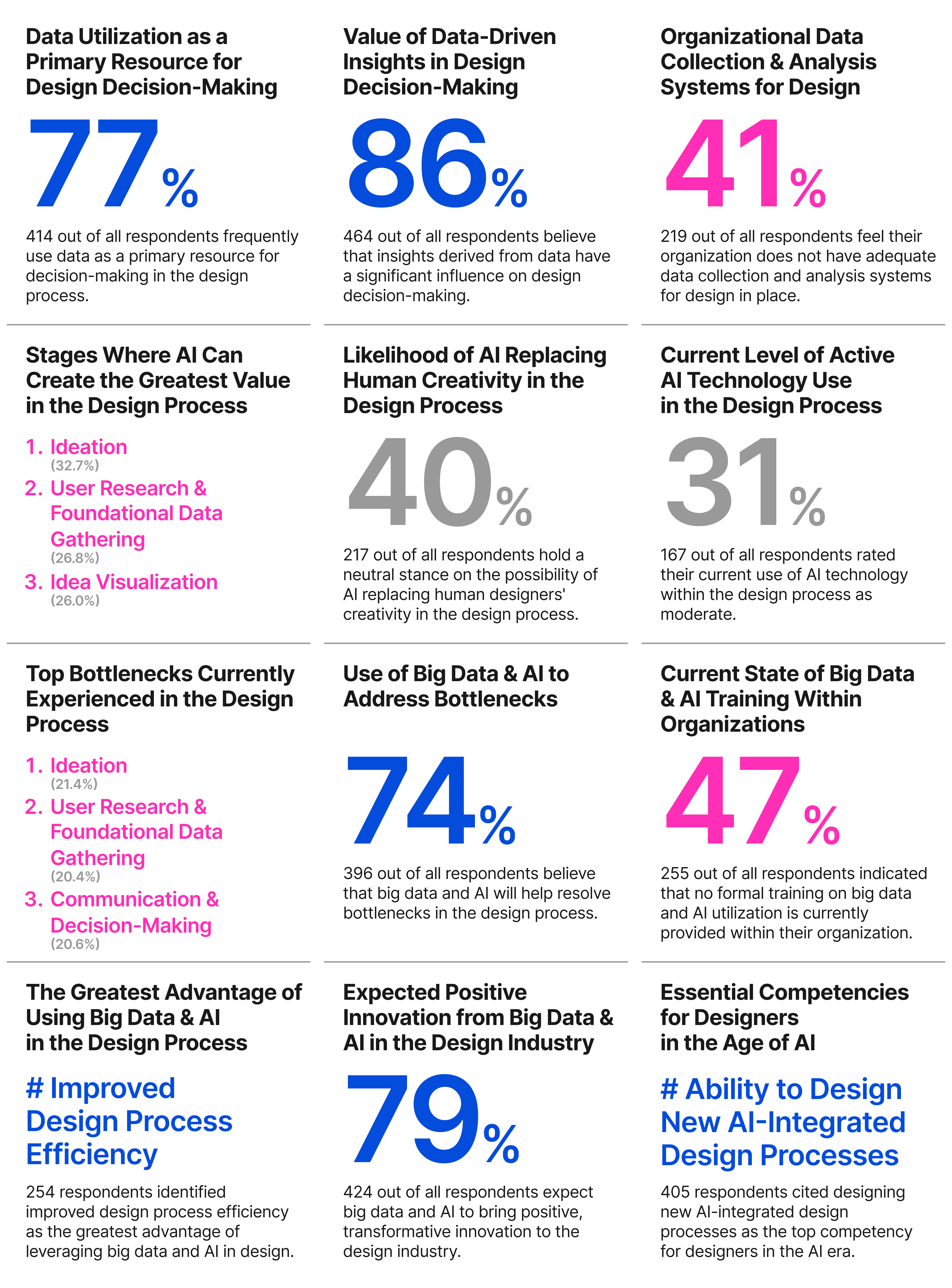 Key findings summary
2 Context
To meaningfully discuss a platform for AI transformation in the design industry, it is first necessary to understand how design stakeholders actually perceive AI and big data in practice. This large-scale survey was conducted to gather foundational data on the current state of generative AI and big data adoption in the domestic design industry, including practitioners’ expectations, concerns, and the competencies they believe will be needed. The broader aim was to explore how designers can respond to technological change while preserving their creative identity and distinct role.
3 Approach
3-1 Survey Design
The survey consisted of 10 demographic items and 40 required response items. The required items were composed of 34 multiple-choice questions and 6 open-ended questions.
- Multiple choice
- Design process and data environment (6 items)
- Data-driven design (6 items)
- Understanding the role of AI (7 items)
- Bottleneck resolution (9 items)
- Future competencies (6 items)
- Open-ended questions covering AI usage experiences in design projects, problems AI could potentially help solve, features needed for data sharing and collection, the role of government and KIDP in supporting AI and big data adoption, and competencies future designers will need.
Structural equation modeling (SEM) was also used to more rigorously examine relationships between respondent perceptions. The analysis targeted items measured on a 5-point Likert scale. All variables and hypotheses were grounded partly in the Technology Acceptance Model (TAM)1 and informed by prior research on data-driven decision-making, data sharing, and generative AI use in design processes.
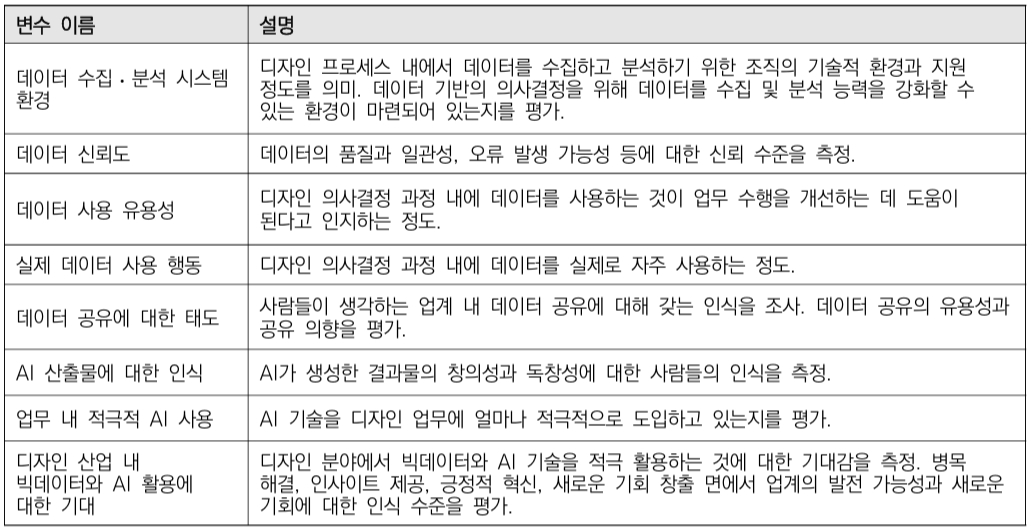 Key variable definitions for structural equation modeling
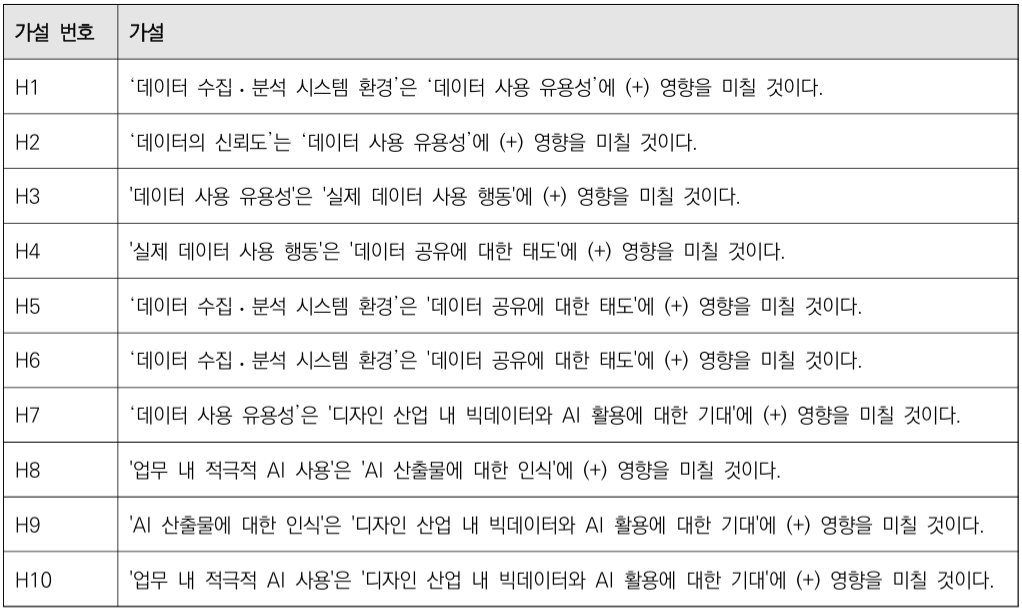 Research hypotheses used in structural equation modeling
3-2 Distribution and Response Collection
The survey targeted design process stakeholders, including:
- Design practitioners (in-house designers, freelance designers, design firm employees, design researchers and educators, etc.)
- Design project stakeholders (planners, managers, design implementation engineers, etc.)
Distribution was carried out through multiple channels to maximize reach: email newsletters and banner placements via KIDP DesignDB membership, homepage pop-ups on industrial design firm websites, direct emails to 535 design firms compiled by the research team, KIDP’s official social media accounts, the research team’s own social media, and distribution through the AI Design Association’s internal community.
 Sample promotional images from the survey campaign
The survey ran from July 25 to October 31, 2024. After filtering for duplicate responses, 538 responses were retained for analysis. The demographic profile of respondents is as follows.
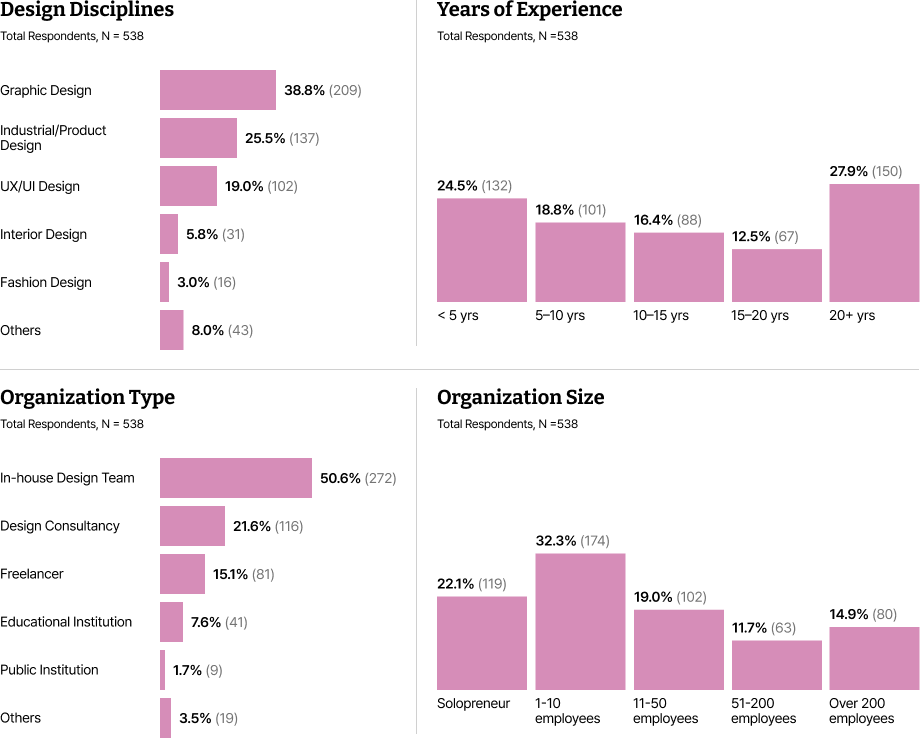 Demographic profile of survey respondents
3-3 Analysis
The analysis was structured across three layers: quantitative statistical analysis to identify overall trends, thematic analysis of open-ended responses to add contextual depth, and structural equation modeling to validate relationships between variables.
- Quantitative Statistical Analysis Closed-ended responses were used to summarize trends across five thematic areas: which stages of the design process are perceived to need data most, how frequently data actually informs decision-making, where AI is expected to create the most value, what bottlenecks are repeatedly experienced, and what competencies future designers will need. This layer was primarily descriptive.
- Thematic Analysis of Open-ended Responses Open-ended responses were analyzed thematically by question. This surfaced the perceived advantages and limitations of AI in design projects, the types of problems practitioners hope AI can solve, the conditions needed for effective design data sharing and collection, directions for government and KIDP support, and the competencies and qualities practitioners believe AI-era designers will need.
- Structural Equation Modeling SEM was applied to items measured on the 5-point Likert scale. Confirmatory factor analysis and structural equation modeling were used to validate item reliability and examine causal relationships between variables.
4 Outcome
4-1 Quantitative Results
Design Process and Data Environment
The design industry recognizes a strong need for data, but the organizational infrastructure to support it remains insufficient.
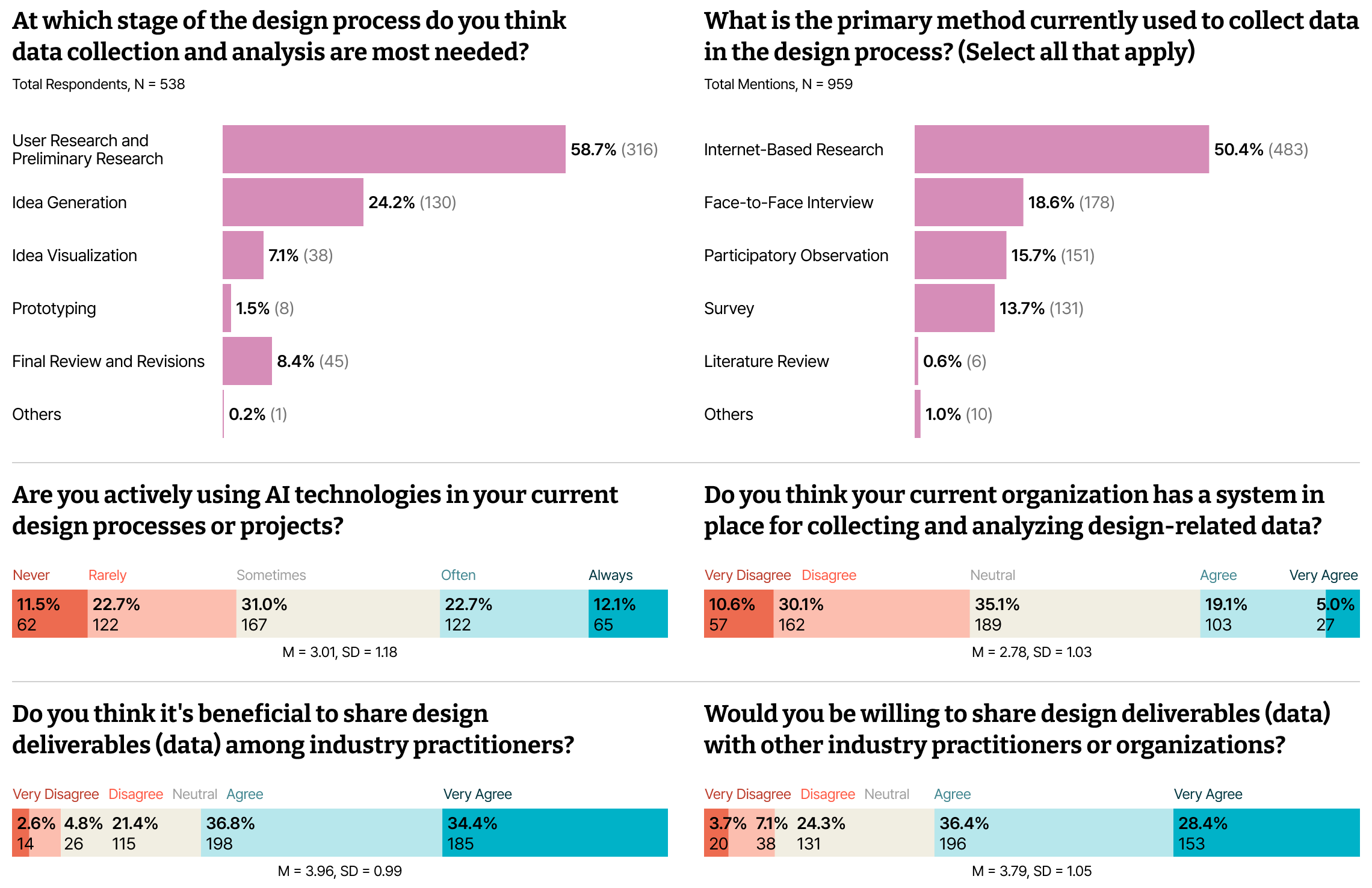
Respondents most frequently identified user research and foundational data gathering (trend analysis, user analysis, etc.) as the stage where data collection is most needed (58.7%). However, satisfaction with their organization’s data collection and analysis systems averaged just 2.78, with over 40% of respondents disagreeing or strongly disagreeing that their organization had adequate systems in place. On the other hand, perceptions of the value of sharing design outputs (mean: 3.96) and willingness to share (mean: 3.79) were comparatively positive. This reveals a gap: practitioners widely recognize the importance of data-driven workflows, but feel their current organizational environment does not yet support them.
Data-driven Design
Data has already established itself as a core input for design decision-making, and its value is most strongly felt in providing evidence and expanding perspective.
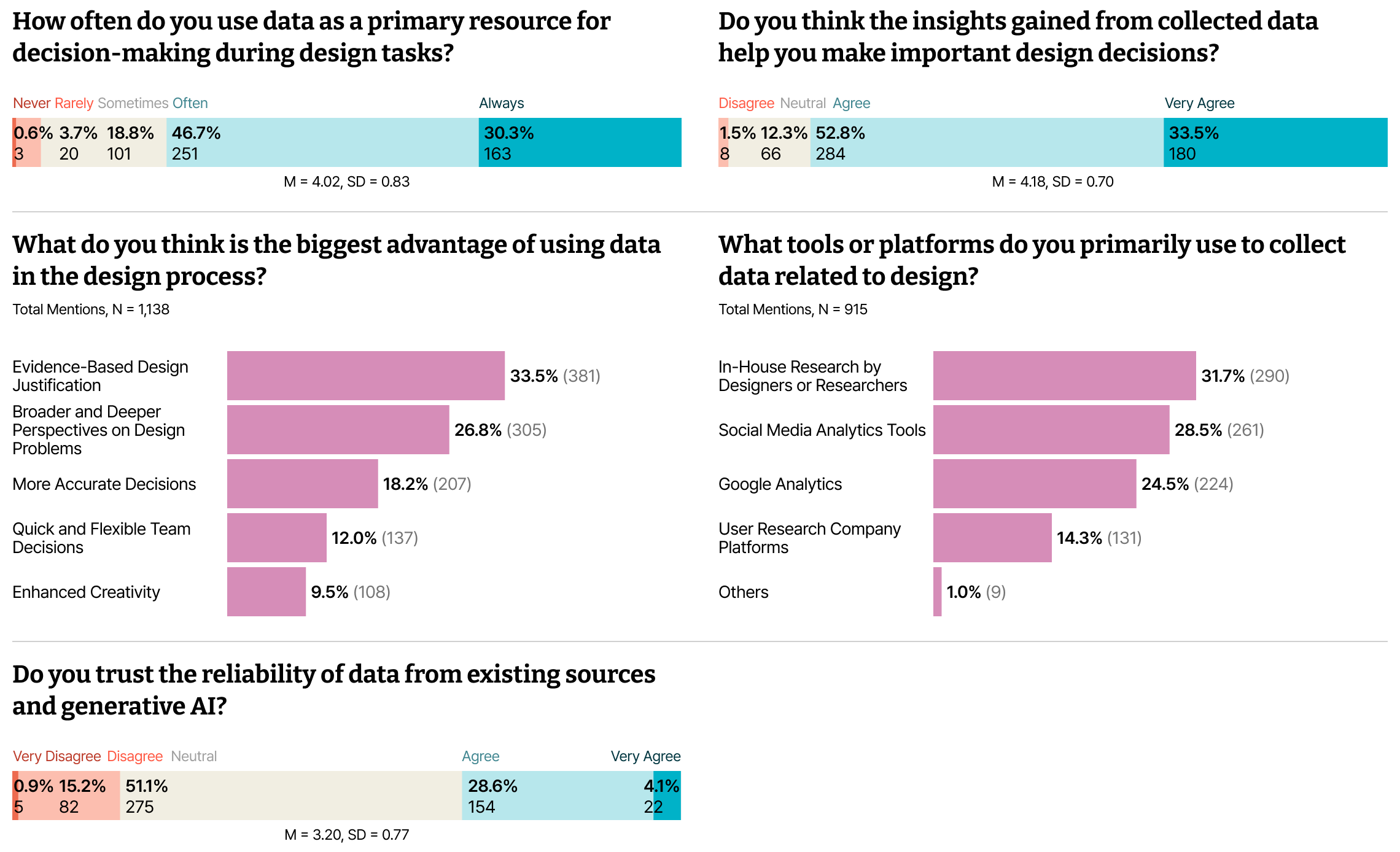
77% of respondents said they frequently or always use data as a primary input for decision-making in design work, and the perceived impact of data-derived insights on design decisions averaged 4.18. The most commonly cited advantage of using data was providing a basis for design decisions grounded in user research (33.5%), followed by offering a broader and deeper perspective on design problems (26.8%). For data collection, 31.7% relied most heavily on internal research conducted by designers and researchers, while 28.5% used social media analytics tools. Data trustworthiness, however, averaged only 3.20, suggesting that while data is widely used, confidence in its reliability remains moderate. Given how central data has become to design practice, this points to a need for more diverse approaches to maximizing data quality and trust.
Understanding the Role of AI
AI is already widely experienced by design practitioners, but it is still seen as a supporting tool in early-stage work rather than a replacement for human creativity.
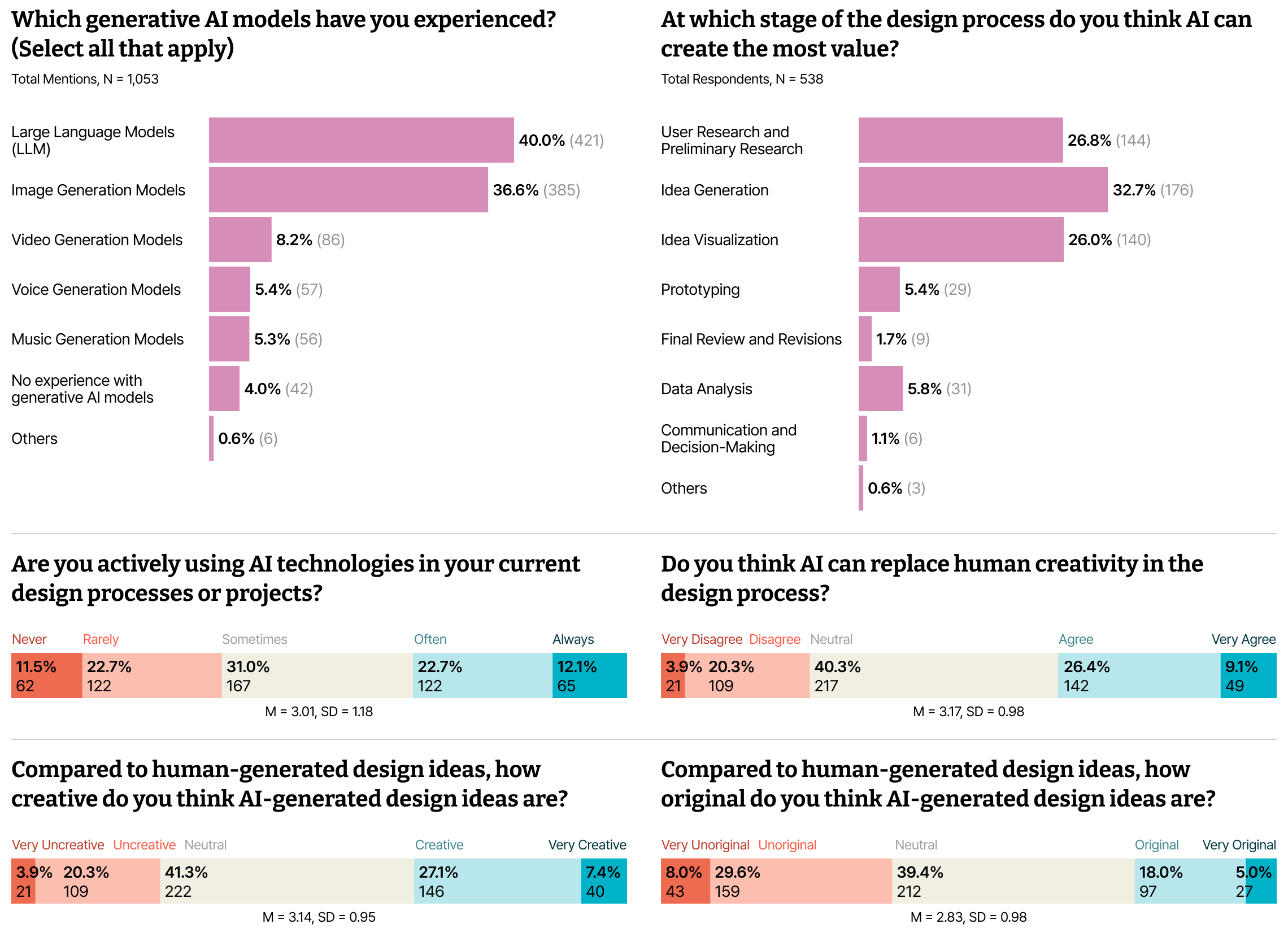
The most commonly experienced types of generative AI were large language models (40.0%) and image generation models (36.6%). The design process stages where respondents expected AI to create the most value were ideation (32.7%), user research and foundational data gathering (26.8%), and idea visualization (26.0%). Attitudes toward whether AI could replace human creativity in the design process were largely neutral (mean: 3.17), and perceived originality of AI-generated ideas averaged just 2.83, notably lower than perceived creativity (mean: 3.14). Practitioners appear to accept AI as a tool that can support creative exploration while stopping short of viewing it as capable of replacing the judgment and originality that define design work.
Bottleneck Resolution
The most acutely felt bottlenecks are concentrated in ideation, communication and decision-making, and user research, and AI is widely expected to serve as a key aid in addressing them.
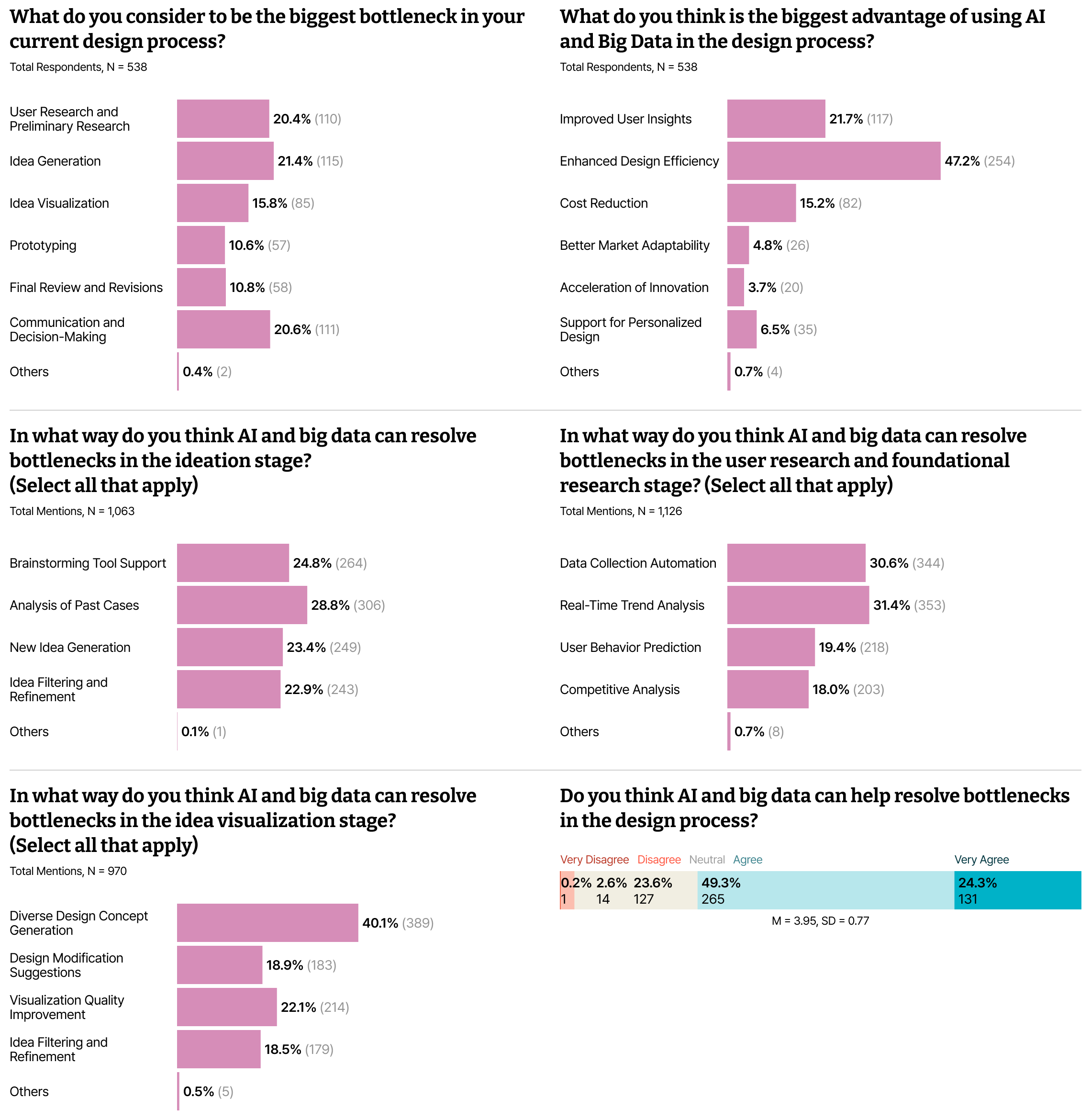
The top bottlenecks in the current design process were ideation (21.4%), communication and decision-making (20.6%), and user research and foundational data gathering (20.4%). Expectations that AI and big data could help resolve these bottlenecks averaged 3.95. Breaking this down by stage, respondents most frequently selected real-time trend analysis (31.3%) and automated data collection (30.6%) for user research, past case analysis (28.8%) and brainstorming support (24.8%) for ideation, and generating diverse design concepts (40.1%) for visualization. These results show that AI is expected to address different types of bottlenecks in different stages of the process. When asked about the greatest overall advantage of AI and big data in the design process, improved design efficiency stood out clearly at 47.2%. AI has already entered the workplace, and practitioners see it primarily as a tool for speed and efficiency.
Future Competencies
The industry holds strong expectations that AI and big data will unlock new insights and drive innovation, but the educational infrastructure to build those capabilities remains underdeveloped.
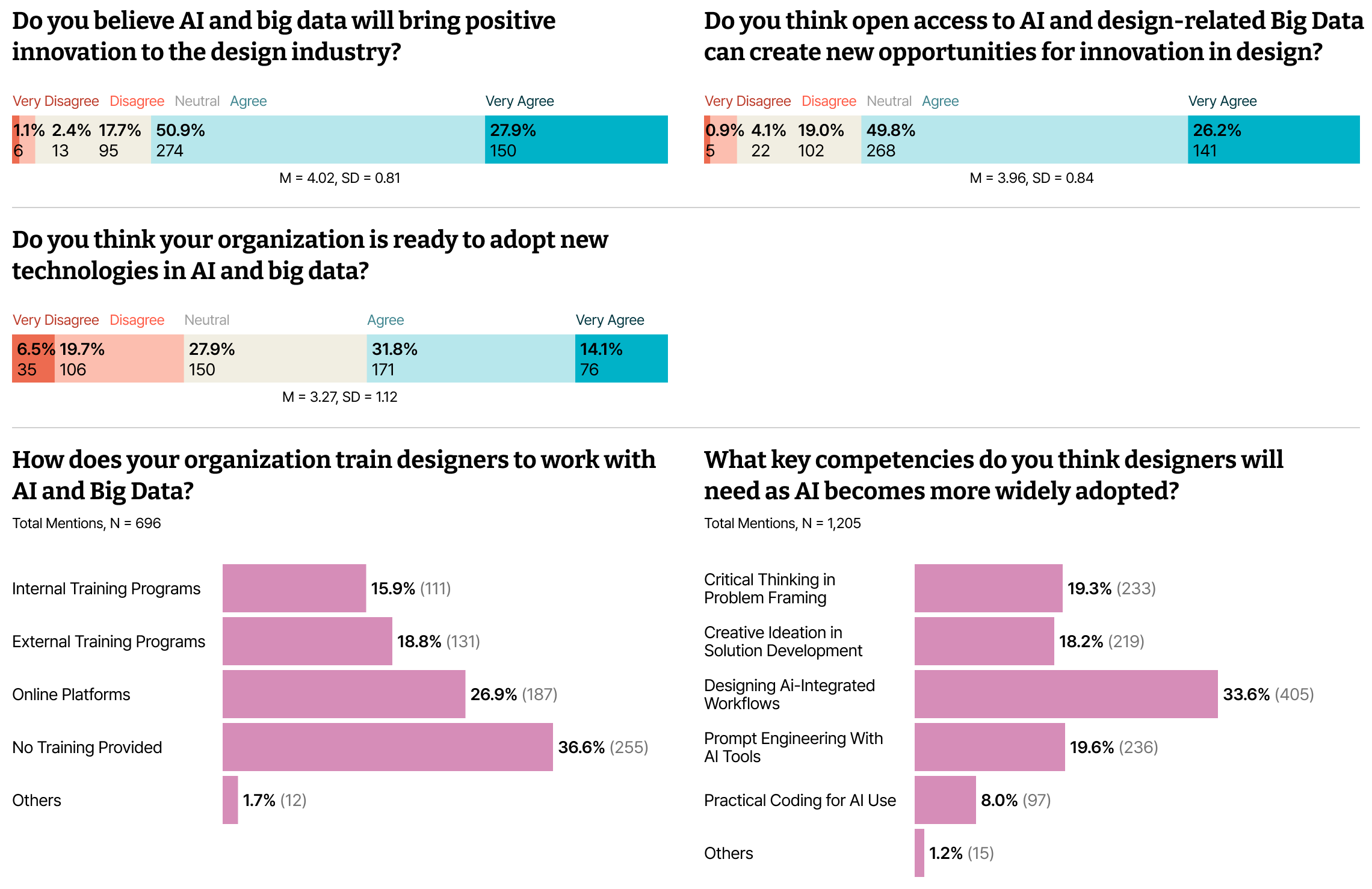
Expectations that AI and big data will bring positive innovation to the design industry averaged 4.02, the highest across all items, while expectations that publicly available AI and design big data will create new opportunities averaged 3.96. 45.9% of respondents also felt their organization was ready to adopt new technologies in AI and big data. Yet when it came to how organizations are actually preparing their designers, “no training provided” was the most common response at 36.6%, followed by online platforms such as YouTube (26.9%). The most important competency future designers will need was identified as the ability to design new design processes that integrate AI (33.6%). The gap between high expectations and limited organizational support came through clearly.
4-2 Structural Equation Modeling Results
Where quantitative statistics reveal trends, structural equation modeling examines how the variables driving those trends connect with one another. Of the 10 hypotheses tested, 7 were statistically significant. The key findings are as follows.
 Hypothesis testing results
First, a well-developed data collection and analysis environment leads practitioners to perceive data use as more useful, and that sense of usefulness translates into actual data use behavior.
The analysis found that the data collection and analysis system environment had a significant positive effect on perceived data usefulness (β=0.137), and perceived usefulness in turn strongly drove actual data use behavior. This means that when practitioners have a capable environment for working with data, it actively promotes real-world adoption.
Second, data trustworthiness matters not just directly, but more broadly as a condition that makes data feel useful.
Data trustworthiness had a positive effect on perceived data usefulness (β=0.180), which in turn promoted actual use behavior. Data trustworthiness also indirectly elevated expectations for AI adoption within the industry, mediated through perceived usefulness (β=0.083). Trust is not simply an attitudinal variable; it is a foundational condition that connects actual use to future-oriented expectations.
Third, hands-on AI experience at work is a direct driver of higher industry-level expectations for AI.
The more actively respondents used AI in their design work, the higher their expectations for AI in the industry (β=0.233). Active AI use also indirectly raised expectations through its effect on perceptions of AI outputs (β=0.072). This suggests that experience does not generate vague optimism; rather, it builds grounded conviction through the judgment that AI actually delivers value.
Fourth, positive perceptions of AI outputs are an important mediating factor in elevating industry-wide expectations for AI adoption.
Perceptions of AI outputs had a significant positive effect on expectations for AI in the design industry (β=0.346). This implies that expanding AI adoption cannot be achieved through tool availability alone. Industry-level acceptance grows only when the outputs of AI are perceived to offer real value.
Conversely, some hypotheses were not supported: the direct effect of actual data use behavior on data sharing attitudes, and its direct effect on industry-level AI expectations, were not statistically significant. This means that simply using data more does not automatically build a culture of sharing or elevate expectations for AI at scale. AI transformation in the design industry is not a matter of usage frequency alone; it gains traction when trustworthy data, a well-designed environment, first-hand experience of usefulness, and positive evaluations of outputs all come together.
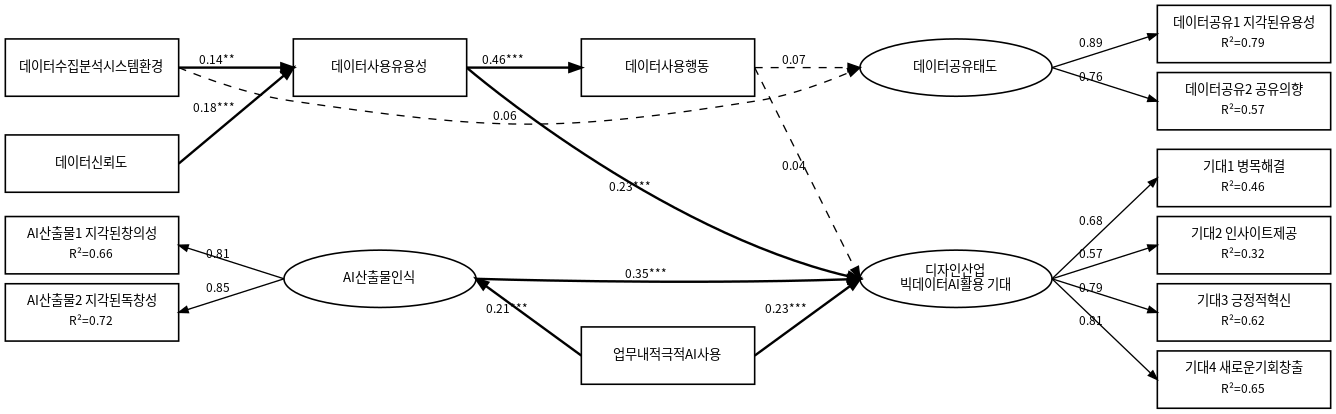 Structural equation modeling results
4-3 Open-ended Response Results
Open-ended responses revealed that practitioners are willing to embrace AI as a tool for efficiency, but continue to feel real tension around controllability and intellectual property.
The advantages of using AI in design projects that came up repeatedly included efficiency gains and cost reduction, and the ability to rapidly explore diverse ideas and visual concepts. The limitations cited most frequently were difficulty controlling AI tools, constraints in achieving detail and consistency, and copyright concerns. Responses such as “if the AI misinterprets the prompt or the output deviates too far from what I had in mind for complex structures, it becomes hard to use” and “we haven’t been able to apply AI-generated designs internally because of copyright issues” illustrated a common pattern: practitioners acknowledge the potential of these tools but face concrete barriers to fully integrating them into their workflows.
For design data sharing and collection, respondents called for dedicated platforms, education and skill development support, mechanisms to address security and intellectual property concerns, and access to open-source and cost-efficient resources. Regarding the role of government and KIDP, there were strong calls for structured training programs, publicly accessible data platforms, subsidies and financial support, and awareness campaigns. The competencies most frequently cited as essential for future designers included AI and data literacy, AI tool proficiency, adaptability and continuous learning, communication skills, and critical thinking and judgment.
5 Reflection
- This project made clear that the challenge of technology adoption is fundamentally a structural one, not a functional one. Practitioners were already actively using data and had some experience with AI. But what was limiting broader adoption was not the absence of tools; it was conditions like data trustworthiness, collection and analysis infrastructure, copyright and security concerns, and the lack of education and clear guidelines. Designing any new service or technology-driven initiative requires getting the environment and trust structures right before anything else, well ahead of the features themselves.
- The research showed that AI’s contribution to creative work tends to concentrate in specific stages. Respondents rated AI’s value most highly in divergent stages such as ideation, early research, visualization, and feedback synthesis. What these stages share is a high degree of uncertainty and repetition. By contrast, respondents were neutral on whether AI could replace human creativity, and rated the originality of AI-generated ideas substantially lower than their creativity. This suggests that positioning AI as an exploration and judgment support system, rather than a substitute for authorship, is likely to be more appropriate and better received. That said, given the pace of AI development, these perceptions may shift considerably as new capabilities emerge.
- Working with a dataset large enough to support structural equation modeling was a genuinely valuable experience. SEM goes beyond correlation to examine causal relationships, which makes it particularly well-suited to understanding systemic dynamics. Being able to apply this methodology in a real research context, rather than a purely academic one, was something I found especially meaningful.